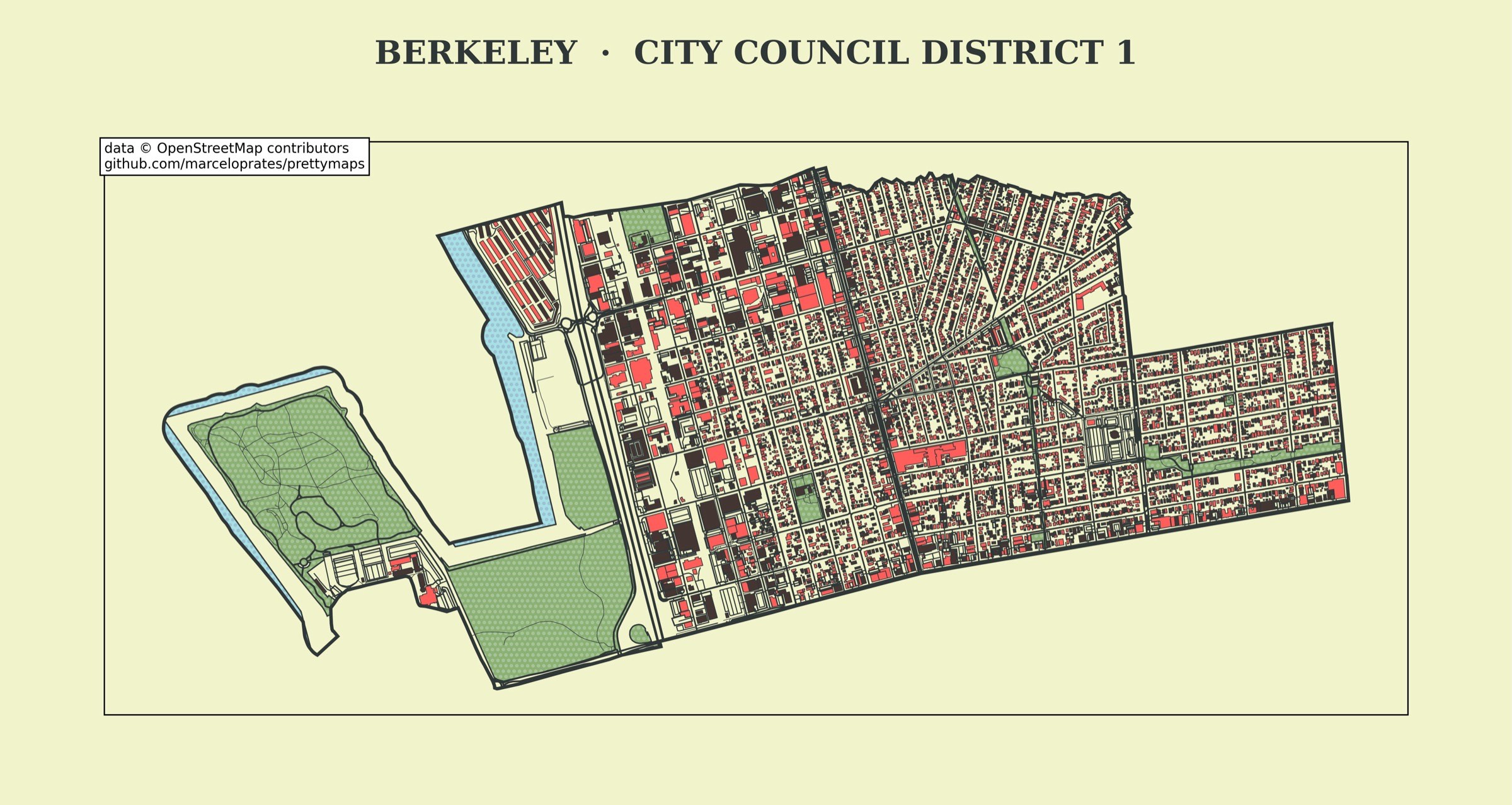
Berkeley City Council · District 1 · The numbers
Who lives, votes, and decides in northwest Berkeley — built from public census and election data, not vibes. Because a campaign that promises accountability should start by showing its own work.
Sources: U.S. Census ACS (2020–24 & 2014–18), 2020 Census redistricting file, California Statewide Database (2022 & 2024). District-level figures are tract/precinct apportionments (±1–2 pts). Planning intelligence, not gospel.
It lands near the citywide median on income, age, education, and renter share, with the most balanced racial mix of any non-student district. There's no dominant bloc to chase — which is exactly why a broad, services-first message fits here.
| Metric | District 1 | Citywide |
|---|---|---|
| Population (2020) | 15,757 | 124,400 |
| White | 51% | 50% |
| Asian | 15% | 20% |
| Hispanic/Latino | 14% | 14% |
| Black | 10% | 8% |
| Median age | 40 | 36 |
| Median household income | $119k | $119k |
| Bachelor's degree or higher | 74% | 75% |
| Foreign-born | 19% | 21% |
| Renter-occupied homes | ~52% | ~55% |

~10,682 registered voters: 76% Democrat, 17% No Party Preference, 3% Republican. Surname-based estimates put registrants at ~9.5% Latino and ~10% Asian (Chinese 4.6%, Indian 1.8%, Japanese 1.7%, Vietnamese 1.1%, Filipino 1.0%, Korean 0.7%), with ~7.8% Jewish-surname.

| Data | Source | Confidence |
|---|---|---|
| Race, population | 2020 Census redistricting file | High |
| CVAP, tenure (2014–18) | ACS 2014–2018 | High |
| Income, age, education, commute, housing | ACS 2020–2024 (apportioned) | Moderate |
| Registration & party | CA Statewide Database, Nov 2024 | High / Moderate |
| Turnout & 2026 projection | CA Statewide Database 2022 & 2024 | High / Low–Mod |
| Surname ethnicity | SWDB surname estimate | Low–Moderate |
Limits: Alameda uses large consolidated precincts (~31 cover Berkeley, ~3 in D1), so precinct analysis is coarse. District figures are area-apportioned. The 2026 win number is a planning range — it moves with field size, undervote, and ranked-choice exhaustion.
Want the money side? Berkeley Budget Basics — a plain-language look at the ~$1.8B budget: where each tax dollar goes, the ~$29M recurring gap, and the ~$2.1B in unfunded infrastructure.